Fully Charged: When Measurement Technology Meets E-Mobility
Peter Hahndorf, Head of Operational Support at NET CHECK, is responsible for the acquisition of measurement data. He and his team take care of data collection — from the technical equipment of vehicles and configuration of measurement systems to procuring the right SIM cards and coordinating vehicles, measurement systems, and technicians.
Peter, can you briefly explain how the measurement vehicles are used?
In our mobile network tests, specially equipped vehicles drive along predefined routes throughout Germany — from highways and country roads to residential areas. These are the so-called drive tests.
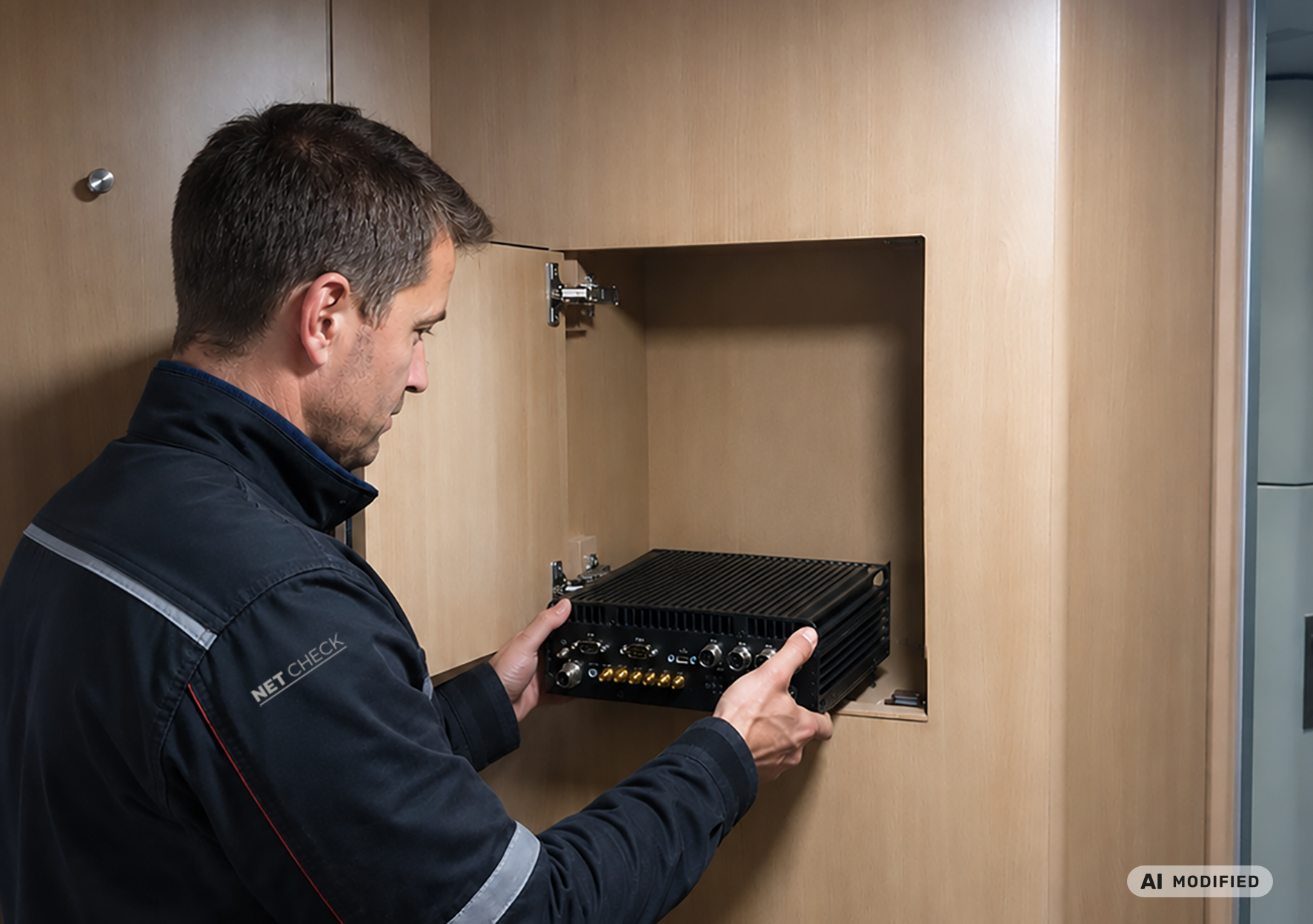
The vehicles are fitted with professional measurement technology: smartphones and scanners that continuously record the network quality of all operators, computers for data processing, and GPS systems for precise positioning. These systems run throughout the measurement drive and collect several million data points per year. This year, we used an electric vehicle in the measurement fleet for the first time to gain practical experience.
Sounds simple: take an EV, drive, measure. Where’s the problem?
The technical implementation of measurement campaigns requires precision on all levels. To ensure that the measurement systems run reliably throughout the day, the power supply must be stable and long-lasting. Even small errors or failures lead to data gaps — and thus to costly repeat drives.
With the electric vehicle, we found that planning becomes more complex. On one hand, range is generally shorter than with conventional vehicles. Additionally, the measurement technology constantly consumes power, which further reduces the available range. In practice, this meant we had to interrupt routes more frequently for charging stops.
Then there’s the charging infrastructure: we need hotels with charging facilities, which are often more expensive. The charging infrastructure itself is still not always reliable — stations can be occupied or out of service. As a result, working time per measurement hour increases, since charging takes longer than refueling. We need to allocate more personnel and time to collect the same amount of data.
This has a direct impact on efficiency. When a measurement vehicle is stationary and charging, it’s not collecting data. As a result, total measurement time increases significantly — meaning more staff hours, more overnight stays, and higher overall resource consumption.
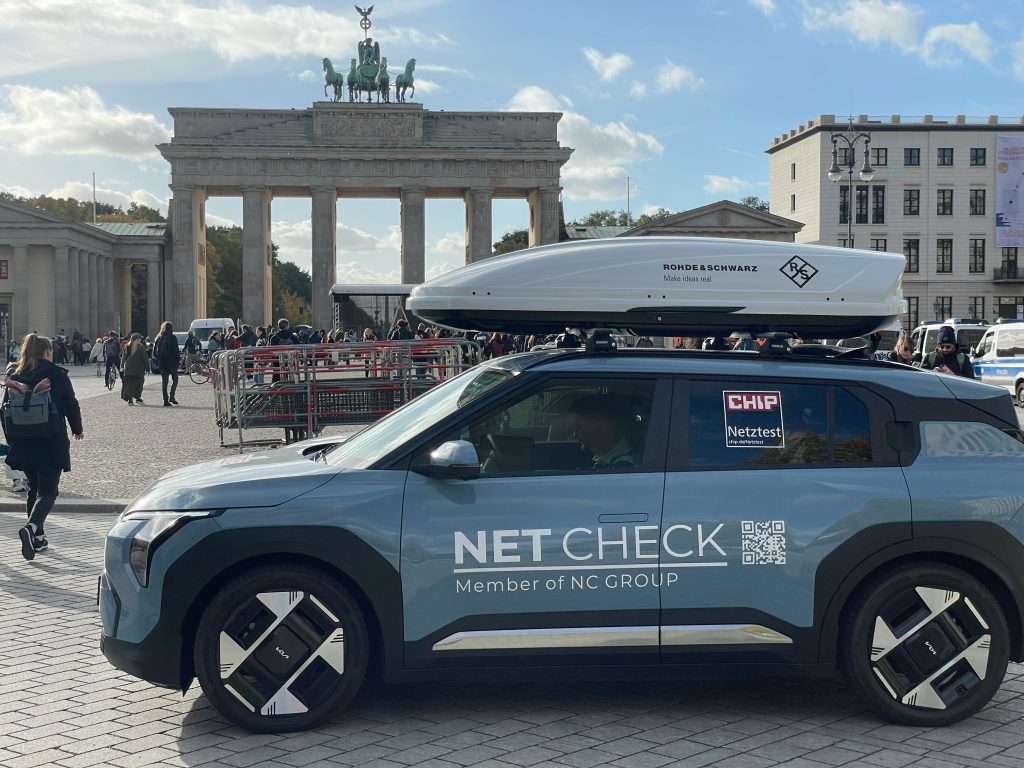
In the 2025 network test, a battery-powered measurement vehicle was also used with the Kia EV3.
E-mobility isn’t exactly new — why conduct the test now?
Sustainability is important to us, which is why we are increasingly relying on e-mobility and continuously working to reduce our carbon footprint. However, during measurement drives, electric vehicles face specific challenges. The reason: the energy demand for the measurement technology is enormous. Scanners, computers, and smartphones — along with the air-conditioning required to regulate the temperature of sensitive equipment — all need to run continuously in addition to the vehicle itself.
A major improvement comes from V2L technology (“Vehicle to Load”), which allows the car’s battery to reliably power external devices — such as the extensive measurement systems. This enables continuous operation of energy-intensive equipment during drives. Kia offers this technology and supports us in data acquisition.
We also receive support from DKV Mobility, which helps us avoid idle fees during overnight charging. Nevertheless, fundamental challenges remain: limited range under real-world conditions, longer downtime due to charging, and an infrastructure that is not yet fully developed or capable of consistently delivering high charging power. For measurement drives with tight schedules and high data requirements, this means significantly more effort.
What does the test with the EV mean for your customers?
The impact is considerable. While the routes themselves remain the same, execution becomes more complex and time-consuming. In practice, this means that a route that can be completed within a given time using a conventional vehicle takes noticeably longer with an EV. More time automatically translates into higher personnel costs, more overnight stays, and overall more complex logistics. These additional costs are real and must be factored into project calculations.
What’s your outlook for future measurement drives?
We’re closely monitoring the development of e-mobility and charging infrastructure because sustainability is a guiding principle that influences all our decisions. As battery capacities grow, charging performance improves, and infrastructure expands, the use of electric vehicles will become simpler, more economical, and make our processes more efficient and flexible. That’s why it’s only natural for us to actively follow these technological advances and incorporate them into our future strategic planning.
The 2025 mobile phone test by NET CHECK and CHIP, probably the toughest test in Germany, will be published shortly. The print magazine will be available at newsagents from 5 December, but the test will be published online before then.