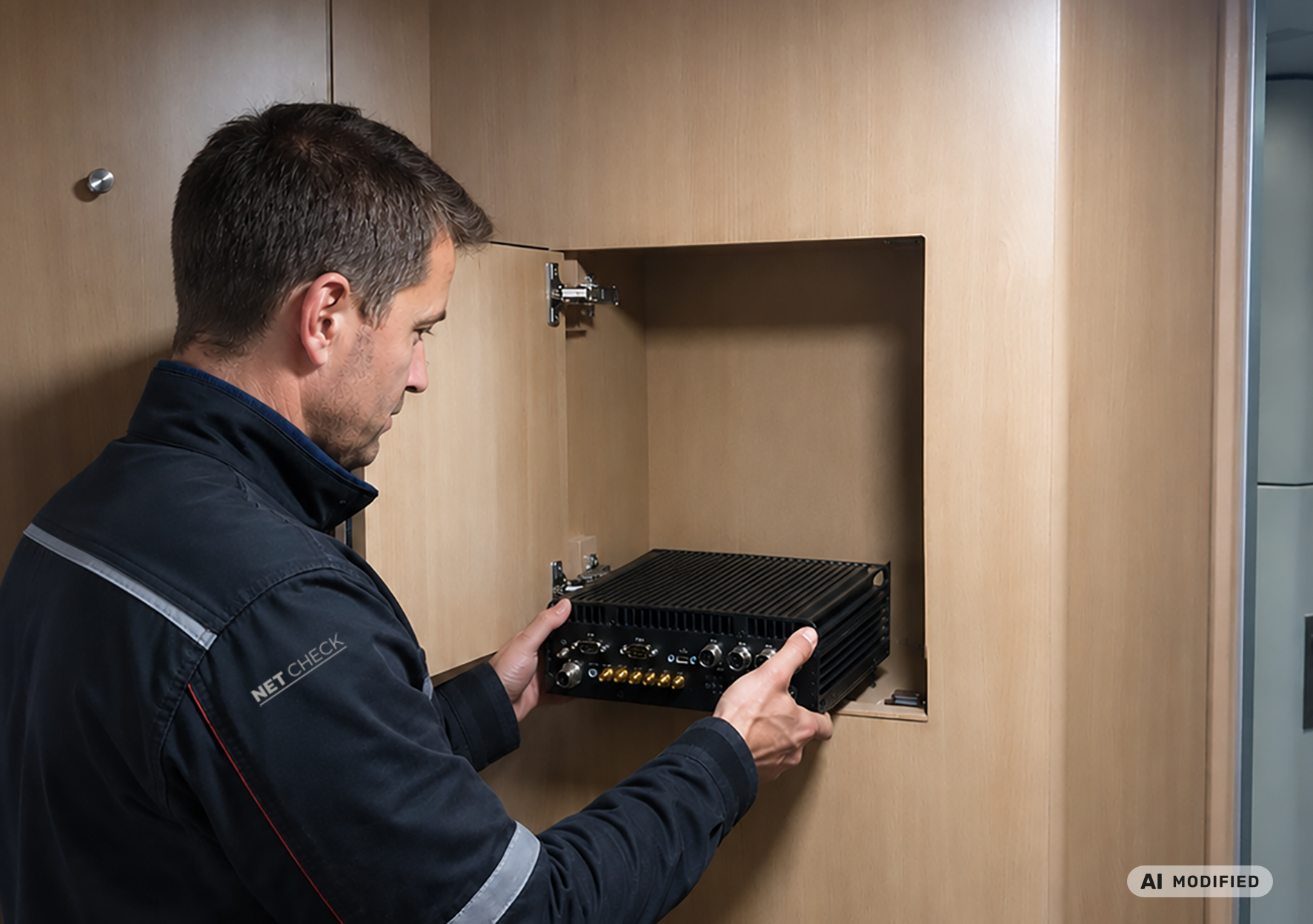
Together with CHIP, NET CHECK has once again conducted Germany’s toughest mobile network test. The result: the three established network operators consistently deliver a high level of performance, led by Deutsche Telekom with a new record score. At the same time, the market entry of 1&1 is bringing additional momentum to the competition and causing noticeable movement in the networks.
Telekom sets new standards
Telekom is once again the clear winner of the test. It has improved on last year’s performance and achieved an overall rating of ‘Excellent’ for the first time. To achieve this, a network must not show any weaknesses and must receive a grade of at least 1.2 in each of the three sub-categories (mobile internet, telephony, network availability). Telekom also tops the 5G rating with a grade of 1.1.
The market leader underlines its strength in cities: Telekom is ahead in four of the five cities surveyed – Berlin, Hamburg, Munich and Leipzig. For users, this means very high speeds, fast call setup times and extremely reliable coverage in everyday life. Web surfing, streaming and phone calls usually work without any problems – outliers have become the exception.
“Germany is a demanding country for mobile communications – it is Europe’s most important transit country, has a huge transport network, complex topography and billions that were paid to the state for frequencies and were then lacking for network expansion. And yet, Germany’s mobile networks are top-notch: Deutsche Telekom achieved an ‘Excellent’ rating for the first time, Vodafone has improved its performance despite 12 million additional users, Telefonica has achieved a “Very Good” rating, and 1&1 has shown that it is a force to be reckoned with. Conclusion: our demanding tests are driving providers to invest more and innovate more – to the benefit of users. We’ll stay on top of it!”
Detlef Zernick, Founder and CEO of NET CHECK
Vodafone, O2 and 1&1
It is also exciting to look at the competition. The switch from 1&1 to Vodafone roaming has significantly shifted network loads. Millions of 1&1 customers now predominantly use the Vodafone network. However, this has not affected the quality of the Vodafone network: despite significantly higher data traffic, the network has improved to an overall score of 1.3, consolidating its position as the second-best provider.
O2 benefits from lower utilisation and is also able to improve its quality. For the first time, O2 receives a very good overall score of 1.5 – the biggest improvement in the entire test field.
1&1 has not yet been evaluated together with the three established networks, but already shows potential in a separate study – especially with regard to planned network expansion and new frequencies from 2026 onwards.
How NET CHECK measures network quality
The test’s significance is based on a combination of professional measurement trips and crowd data. NET CHECK evaluated billions of data records, anonymised from more than 1.5 million devices, covering almost all residential and traffic areas in Germany. This allows network availability and performance to be assessed in a particularly realistic manner from the user’s perspective in everyday life.
At the same time, measurement vehicles and teams were on the road throughout the country: around 8,400 kilometres by car, 76 hours on foot and by public transport in city centres, and over 2,600 kilometres on long-distance trains. For the first time, a purely battery-powered measurement vehicle, the Kia EV3, was also used. This vehicle is equipped with V2L (Vehicle to Load) technology, which allows the vehicle battery to supply external devices with sufficient power, thus ensuring the continuous operation of the energy-intensive measurement systems during the measurement trips. The measurement trips were also supported by DKV Mobility, which provided access to more than 100,000 charging points in Germany and made overnight charging particularly easy.
City, countryside, 5G – and the situation on trains
The evaluation shows that coverage with fast data rates is now very high in cities. When surfing the web with typical requirements, all three networks work reliably almost everywhere. In rural areas, the picture is more mixed – fast connections are less widely available here, even though the networks are continuously catching up. Telekom, Vodafone and O2 are making visible progress in expanding 5G, especially with the powerful N78 band in urban areas.
Mobile coverage remains a particular challenge on long-distance trains, where connection errors continue to occur frequently. Even though other measurements show partial improvements in the networks, these quality enhancements are clearly not reaching all passengers on trains. To ensure that the signal reaches them as effectively as possible, a technological shift is currently underway from repeater systems to mobile-permeable windows.

The big mobile phone test 2025/2026 by CHIP and NET CHECK: Performance in cities. (Source: CHIP)
Conclusion: Three top networks – NET CHECK sets the pace
The joint test by NET CHECK and CHIP proves that Germany’s mobile networks are better than their reputation. Three providers achieved a very good overall score or higher, with Telekom setting the bar high with the first ‘excellent’ rating, Vodafone impressing despite additional roaming load, and O2 making significant gains in quality. 1&1 shows that further competition is on the horizon – with noticeable potential for the coming years.
With its extensive measurement campaigns and combination of driving and crowd data, NET CHECK sets the standard for objective network evaluation in Germany. The results create transparency for consumers and serve as an important benchmark for network operators. One thing is clear: the foundation is strong today – and with expansion goals, 5G and growing data hunger in mind, there is still plenty of room for further improvement.
The complete test can be found here (in German): https://www.chip.de/netztest